
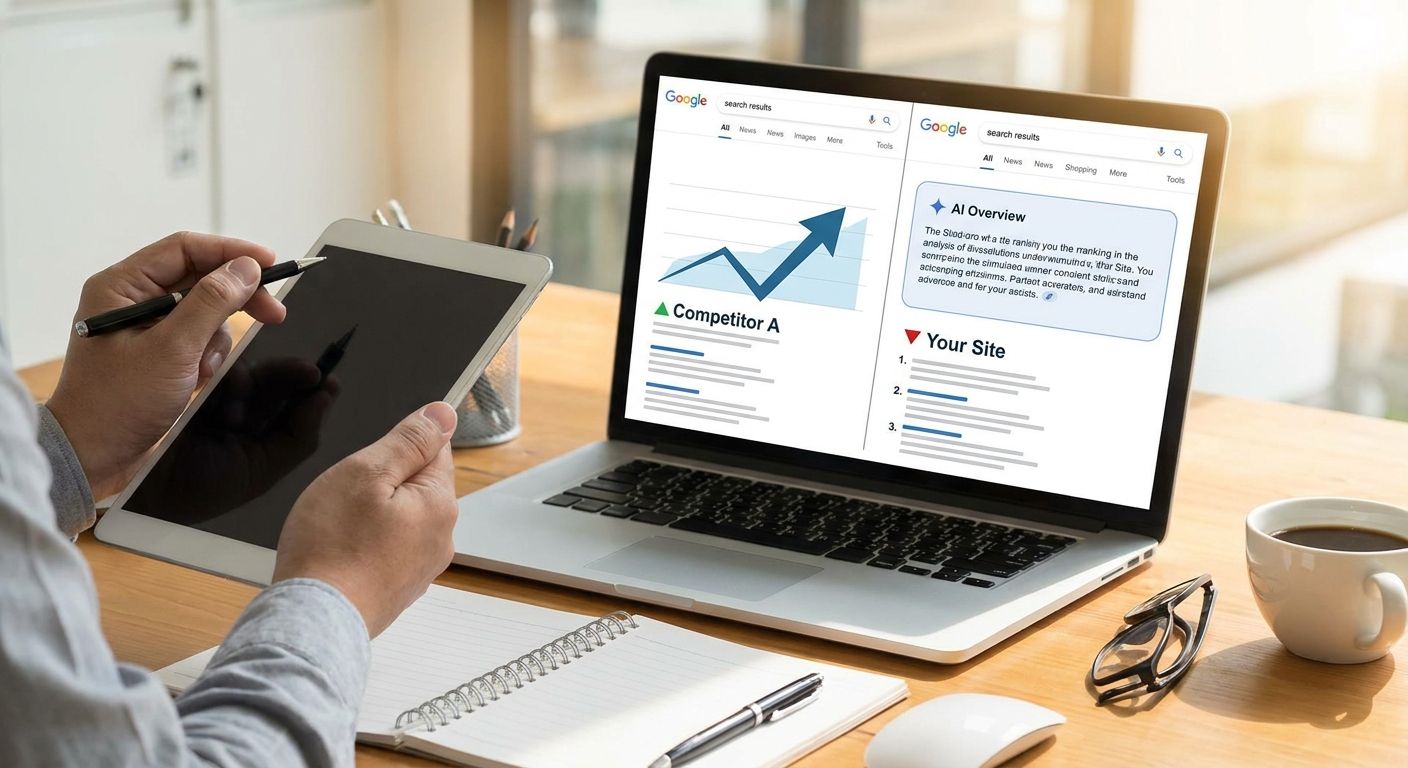
Competitors don't need to outrank you in Google to steal your customers anymore — they just need ChatGPT to name them first. This guide walks through the exact checks that reveal whether rivals are winning the answer, not just the search result page, and what to do the moment you spot it in 2026.
- Run the same 15-20 buyer prompts across ChatGPT, Gemini, Claude and Perplexity monthly to catch competitors outranking you in AI search.
- A citation with no link is still a loss — track mentions, not just referral traffic, or you'll miss most of the picture.
- If a rival appears in 60%+ of prompts where you're absent, that's a visibility gap, not noise.
- An AI Visibility Score benchmarked against named competitors turns scattered screenshots into a trackable metric.
- Fix the pages the answer engines are actually citing before you touch anything else — verdict: prioritize source pages over volume.
Why this matters
Google rankings are visible and stable enough to check with a rank tracker. AI answers are neither. The same prompt returns a different brand list depending on the day, the model version, and whether the assistant has browsing turned on.
That volatility is exactly why most teams don't notice competitors outranking them in AI search until a prospect mentions it in a sales call. By then the pattern has usually existed for months. Checking manually, prompt by prompt, catches maybe a third of what's happening — the rest lives in conversations nobody at your company ever sees.
A structured competitor check, run on a schedule, turns a vague feeling ("I think we're losing ground in ChatGPT") into a number you can act on. Koalr builds that number as an AI Visibility Score benchmarked against named rivals, so the comparison isn't a one-off screenshot exercise.
What you'll need
- A list of 15-25 real buyer prompts — not brand-name searches, but the questions a prospect actually types ("best CRM for a 20-person sales team", not "[your brand] reviews")
- Access to ChatGPT, Gemini, Perplexity and Claude, ideally on paid tiers where citations and sources are visible
- A list of 3-5 named competitors you already compete with in organic search or paid ads
- A spreadsheet or a tool like Koalr's competitor benchmarking to log results consistently, not from memory
- 45-60 minutes for the first manual pass, less once you automate it
The steps
1. Build a prompt set that mirrors real buying questions
This step accomplishes the single most important thing in the whole exercise: making sure you're testing what buyers actually ask, not what your marketing team wishes they asked.
Pull the last 90 days of sales call transcripts, support tickets, and "why did you choose us" survey answers if you have them. Extract the phrasing prospects used before they knew your brand name. Aim for a mix: comparison prompts ("X vs Y"), category prompts ("best tools for Z"), and problem-first prompts ("how do I solve Z").
Common mistake: testing only branded prompts like "is [competitor] good". Those tell you almost nothing about whether competitors outrank you in AI search for the moments that matter — the unbranded, top-of-funnel question where nobody has picked a side yet.
2. Run the same prompts across all four major engines
AI answer engines don't agree with each other. Perplexity leans on live web sources, Google AI Overviews leans on indexed pages with structured data, and ChatGPT's answer depends heavily on which model and browsing mode is active in 2026.
Run every prompt in ChatGPT, Gemini, Claude and Perplexity, in a fresh session each time (logged out or with history off, where possible) to avoid personalization skewing results. Log which brands get named, in what order, and whether a link or citation accompanies the mention.
Expected outcome: a raw table of 15-25 prompts by 4 engines, each cell showing who got mentioned. Common mistake: running prompts only once. Model outputs vary run to run — repeat each prompt twice and keep the pattern, not the outlier.
3. Score presence, not just first place
Unlike a Google results page, AI answers rarely have a single "rank one". A model might name three brands in a sentence with no clear order. What matters is presence rate: the percentage of prompts where you appear at all, compared to the same rate for each named competitor.
Calculate it per engine and as a blended score. If a competitor shows up in 70% of your prompt set and you show up in 30%, that gap is the real story — not which name happened to come first in one answer.
This is where a dedicated AI Visibility Score earns its keep: it turns scattered presence rates into one trackable number you can watch move month over month, instead of re-running the math by hand every time.
4. Check whether mentions come with a citation or a link
A brand name dropped mid-sentence with no source is a mention. A brand name tied to a clickable source, a cited domain, or an explicit "according to X" is a citation — and citations convert differently.
Go back through your prompt log and mark each brand mention as either "named only" or "cited with source". Competitors that get cited, not just named, are the ones the model trusts as a reference point, and that trust compounds the more often it happens.
Expected outcome: you'll usually find a competitor with a lower mention rate but a higher citation rate — meaning fewer answers include them, but when they do, the model treats them as the authority.
5. Trace citations back to the source page
When a competitor gets cited, the model pulled that citation from somewhere — a comparison page, a review site, a pricing page, a Reddit thread. Find that page. This is the step most teams skip, and it's the one that actually tells you what to fix.
Open the cited URL. Check its structure: does it answer the question directly in the first paragraph, does it use clear headings, does it include specific numbers instead of vague claims. AI answer engines favor pages that make the extraction easy.
Common mistake: assuming the competitor's homepage is the source. It almost never is — it's usually a third-party comparison article, a review aggregator, or their own well-structured blog post targeting the exact prompt phrasing.
6. Log results monthly and watch the trend, not the snapshot
One pass tells you where you stand today. Six months of passes tell you whether competitors outranking you in AI search is getting worse, holding steady, or improving because of something you changed.
Set a recurring calendar block — the first week of every month works well — and re-run the identical prompt set. Resist the urge to add new prompts every cycle; consistency is what makes the trend line meaningful. A GEO audit run quarterly, layered on top of the monthly prompt checks, catches structural issues the raw scores miss.
See your AI Visibility Score
Benchmark your brand against named competitors across ChatGPT, Gemini, Claude and Perplexity.
Troubleshooting
Every engine gives a different answer to the same prompt. That's expected behavior, not a broken test — log each engine separately and only compare blended averages across a full month, never a single run.
A competitor appears constantly but you can't find where the model is pulling it from. Try adding "according to what source" or "cite your sources" to the prompt in Perplexity or ChatGPT with browsing on — most models will surface the underlying page when asked directly.
Your brand shows up in Google AI Overviews but never in ChatGPT. These pull from different indexes and weight different signals — AI Overviews leans heavily on your existing organic rank, while ChatGPT's answer (outside browsing mode) reflects training data and any live retrieval it's configured to use.
Results seem to shift week to week with no clear cause. Model updates roll out continuously through 2026 without public changelogs for every tweak — this is why a single check is close to worthless and a monthly cadence is the minimum useful interval.
You can't tell if a mention helped or hurt. Read the surrounding sentence. "X is a solid budget option but lacks Y" is a mention with a caveat attached — log the sentiment, not just the name.
The prompt set feels stale after a few months. Refresh 20-30% of prompts each quarter based on new sales call language, but keep a stable core so month-over-month comparisons still hold.
Tools and resources
- A spreadsheet template with columns for prompt, engine, brands mentioned, citation yes/no, and source URL
- Koalr for automated competitor benchmarking, an AI Visibility Score, and a Prompt Explorer that logs answer engine responses without manual copy-pasting
- The paid tiers of ChatGPT, Gemini, Claude and Perplexity, since free tiers often cap browsing and citation visibility
- A running log of sales call language to keep your prompt set grounded in real buyer questions rather than guesses
What to do next
Once you know which competitors outrank you in AI search and on which prompts, the next move is fixing the source pages the models are citing against you — structuring your own comparison and category pages the same way, with direct answers up front and specific numbers instead of vague claims. A recurring GEO audit is the natural next layer once monthly prompt checks are routine.
FAQ
How do I know if competitors are outranking me in AI search?
Run the same set of 15-25 buyer prompts across ChatGPT, Gemini, Claude and Perplexity and compare how often each competitor gets named versus you. A consistent gap of 40+ percentage points across a monthly check is a real signal, not noise.
Is AI search visibility the same as ranking on Google?
No, they're measured differently. Google ranking is a position on a results page; AI visibility is how often and how favorably a model names your brand across varied prompts, which can move independently of your organic rank.
What's the best tool to track AI visibility against competitors in 2026?
A dedicated platform like Koalr tracks an AI Visibility Score and benchmarks it against named competitors automatically, which is faster and more consistent than manual prompt logging in a spreadsheet.
How often should I check if competitors outrank me in ChatGPT or Gemini?
Monthly, at minimum, using an identical prompt set each time. Model outputs shift with updates that roll out continuously, so a single check only captures one moment in a moving pattern.
Does a brand mention in ChatGPT without a link still count as a loss?
Yes. A competitor named in an answer with no clickable source still shapes the buyer's shortlist before they ever visit a website, so tracking mentions alongside citations matters more than tracking clicks alone.
Why does Perplexity show different competitors than Google AI Overviews?
Perplexity pulls heavily from live web sources at query time, while Google AI Overviews weighs your existing organic ranking and structured data more heavily, so the two surfaces reward different signals.
What should I fix first if a competitor keeps getting cited over me?
Find the exact page the model is citing for the competitor and rebuild your equivalent page to answer the same question directly in the first paragraph with specific numbers, since AI answer engines favor pages that are easy to extract from.
Can a GEO audit replace manual prompt checking?
A GEO audit adds structural analysis of your pages and technical signals on top of prompt checks, but it works best as a quarterly layer over an ongoing monthly prompt check, not a replacement for it.
One last thing
The competitor that worries teams most in 2026 usually isn't the one ranking above them on Google — it's the one showing up in a comparison article on a site neither company owns, getting cited by name every time a model pulls that page as a source. Chase that citation, not the search position.
If you only do one thing after reading this: trace one AI-cited page back to its source this week and check whether your own equivalent page could win that same citation with a clearer opening paragraph.