
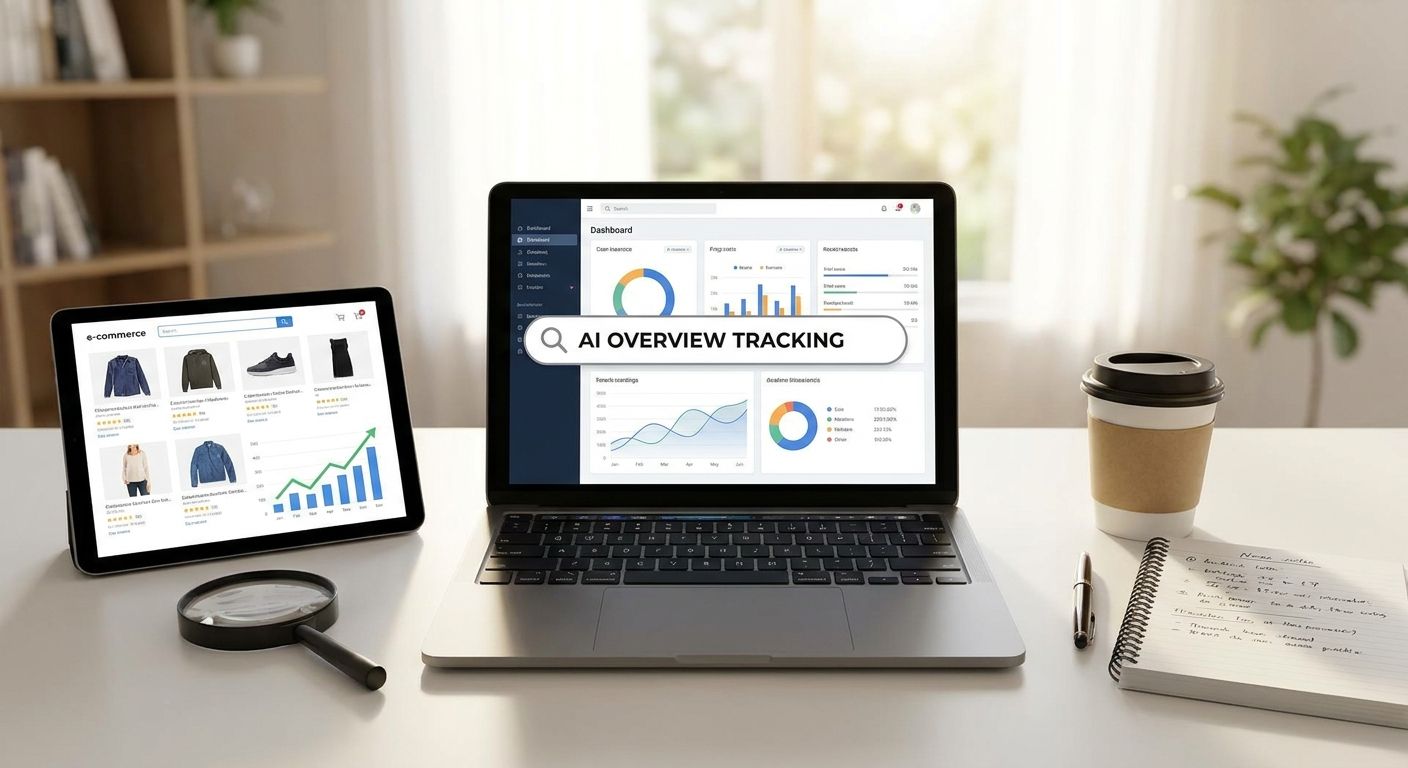
E-commerce brands lose product recommendations to competitors inside ChatGPT and Google AI Overviews every day, and most marketing teams have no idea it's happening. AI overview tracking for e-commerce brands means monitoring which merchants get named when shoppers ask "best noise-canceling headphones under £150" or "where to buy organic dog food" — not just watching organic rankings.
- AI overview tracking ecommerce requires monitoring 5 answer engines, not just Google — ChatGPT, Gemini, Perplexity, Claude and Google AI Overviews each cite differently.
- A platform built for this, like Koalr, scores brand presence on a 0-100 AI Visibility Score instead of guessing from GA4 referral traffic.
- Generic SEO rank trackers retrofitted for AI Overviews miss citations that never produce a click — the biggest blind spot for 2026 buying journeys.
- Check weekly, not monthly: shopping-intent prompts shift which merchant gets named far faster than organic rankings do.
- Manual spot-checks work for spot audits but can't benchmark you against competitors across every engine at once.
Why this matters for e-commerce in 2026
A shopper who asks ChatGPT "what's the best running shoe for flat feet" never sees your product page unless a large language model names your brand in its answer. That's a lost sale with zero trace in Google Analytics — no referral, no session, no conversion event. The AI visibility platform at Koalr exists because this gap is now the difference between a brand that gets recommended and one that gets skipped entirely.
SEO rank trackers tell you where your product page sits on page one. They say nothing about whether Perplexity cited a competitor's comparison guide when a shopper asked which brand to buy. Ecommerce sits at the center of this shift because so much shopping research now starts as a conversational query, not a search term.
Who this is for
This guide is for D2C and multi-brand ecommerce marketing teams — the person who owns organic growth, paid, or brand strategy and needs to know if their SKUs get named in AI-generated shopping answers before a competitor's marketing lead figures it out first. If your catalog includes comparison-heavy categories (electronics, beauty, outdoor gear, supplements), this applies to you directly in 2026.
What to look for in AI overview tracking for ecommerce
Coverage across every engine shoppers actually use
Shoppers don't only use Google. A tool that only watches Google AI Overviews misses ChatGPT, Gemini, Perplexity and Claude — engines increasingly used for pre-purchase research in 2026. Coverage across all 5 matters more than depth on one.
A score you can benchmark against competitors
Raw citation counts mean nothing without context. A 0-100 AI Visibility Score, benchmarked against named competitors, tells you if you're winning the category or losing it — and by how much.
Prompt-level visibility, not just brand-level
You need to see which specific prompts surface your brand and which surface a rival. A feature like Prompt Explorer matters because it shows the exact query where a competitor got cited instead of you, so the fix is a page edit, not a guess.
Citation tracking that doesn't rely on clicks
GA4, Similarweb and Semrush only see AI referral traffic that produces a click. A citation that convinces a shopper without a click never shows up there. Tracking needs to catch the mention itself, not just the resulting session.
Update frequency matched to shopping cycles
Product rankings inside AI answers shift faster than organic SERPs — new reviews, restocks and seasonal demand all move the needle. Checking every 7 days catches shifts that a monthly or quarterly audit misses entirely.
Competitive leaderboard visibility
Knowing your own score in isolation is half the picture. An AI Visibility Leaderboard that ranks you against named competitors in your category shows exactly who's eating your recommendation share.
Top approaches, ranked
The specialist — AI visibility platforms built for this. Koalr tracks brand presence across all 5 major answer engines and produces a 0-100 AI Visibility Score with competitor benchmarking built in. The spec that matters: coverage of citations that never generate a click, which is the exact traffic GA4 can't see. Buy for any ecommerce team running comparison-heavy categories in 2026.
The free option — manual prompt spot-checks. Running the same 10-15 shopping prompts through ChatGPT and Gemini by hand costs nothing and catches obvious gaps fast. It doesn't scale past a handful of prompts and gives you zero historical trend or competitor score. Consider as a stopgap, not a system.
The retrofit — generic rank trackers with an "AI Overview" bolt-on. Several SEO platforms added an AI Overview column to existing rank-tracking dashboards in 2025 and 2026. They catch Google's AI Overview presence but usually stop there, missing ChatGPT, Claude and Perplexity entirely. Consider only if Google AI Overviews is your sole concern.
The heavy option — enterprise GEO consultancy audits. Agencies running one-off generative engine optimization audits give a thorough snapshot but typically deliver findings on a quarterly cadence. Given how fast shopping-intent prompts shift, a quarterly snapshot is stale within weeks. Skip unless paired with continuous tracking between audits.
The blind spot — Google Search Console alone. GSC shows impressions and clicks for traditional search but doesn't isolate AI Overview citation performance the way a dedicated tool does, and it says nothing about ChatGPT, Claude, Gemini or Perplexity. Skip as a standalone solution for ecommerce brands chasing AI recommendations.
See your AI Visibility Score
Check where your brand stands across ChatGPT, Gemini, Perplexity, Claude and Google AI Overviews.
What to avoid
- Trusting GA4 referral traffic as the whole picture. A citation that never produces a click is invisible in Analytics but still shapes whether a shopper buys from you or a competitor.
- One-time GEO audits with no follow-up tracking. A single snapshot from early 2026 tells you nothing about whether a June product launch changed your standing by autumn.
- Optimizing only for Google AI Overviews. Ecommerce shoppers increasingly open ChatGPT or Perplexity for comparison questions before they ever touch a Google search box.
Verdict comparison
| Approach | Engines covered | Competitor benchmarking | Verdict |
|---|---|---|---|
| Koalr (AI visibility platform) | 5 (ChatGPT, Gemini, Perplexity, Claude, Google AI Overviews) | Yes, 0-100 score + leaderboard | Buy |
| Manual prompt spot-checks | Whatever you test by hand | No | Consider |
| Generic rank tracker + AI add-on | Usually Google only | Limited | Consider |
| Enterprise GEO consultancy audit | Varies, quarterly cadence | Yes, but stale fast | Skip standalone |
| Google Search Console alone | Google only, impressions/clicks | No | Skip |
FAQ
What is AI overview tracking for ecommerce brands?
AI overview tracking for ecommerce brands means monitoring whether your products and brand name get cited when shoppers ask ChatGPT, Gemini, Perplexity, Claude or Google AI Overviews buying-related questions. It's distinct from organic rank tracking, which only measures traditional search results.
Is AI visibility tracking different from AI traffic analytics?
Yes. AI traffic analytics tools like GA4 and Similarweb only measure sessions that came from an AI answer engine click. AI visibility tracking catches citations and mentions that never produced a click at all, which is most of them.
How often should ecommerce brands check AI Overview presence?
Check weekly rather than monthly or quarterly in 2026. Shopping-intent prompts shift faster than organic rankings, especially around new product launches, restocks and seasonal demand.
Does Google AI Overview send referral traffic I can see in GA4?
Sometimes, but only when a shopper clicks through from the AI Overview to your site. Many citations influence a purchase decision without any click at all, so GA4 undercounts your real AI visibility.
Can ChatGPT recommend my product without sending any traffic?
Yes. If ChatGPT names your brand as the answer to a shopping question inside the chat, a purchase decision can happen without the shopper ever visiting your site or Analytics logging a session.
What is an AI Visibility Score?
An AI Visibility Score is a 0-100 measure of how consistently your brand gets cited across major answer engines compared to named competitors. Koalr generates this score alongside a competitor leaderboard.
Do I need separate tools for ChatGPT and Google AI Overviews?
Not if the platform covers both. A single AI visibility tool tracking all 5 major engines saves the manual work of separately monitoring ChatGPT, Gemini, Perplexity, Claude and Google AI Overviews one at a time.
Is a quarterly GEO audit enough for ecommerce brands?
No. A quarterly audit gives a snapshot that's already stale by the time a new product line or seasonal campaign launches. Continuous weekly tracking catches shifts a quarterly report misses entirely.
One last thing
The brands that show up in AI Overviews and ChatGPT answers in 2026 aren't necessarily the ones with the strongest domain rating — they're the ones whose product pages, reviews and comparison content answer the exact question a shopper typed. Chasing traditional backlinks without checking your AI Visibility Score first is optimizing for a search engine that's shrinking share every year AI answer engines take a bigger cut of shopping research.